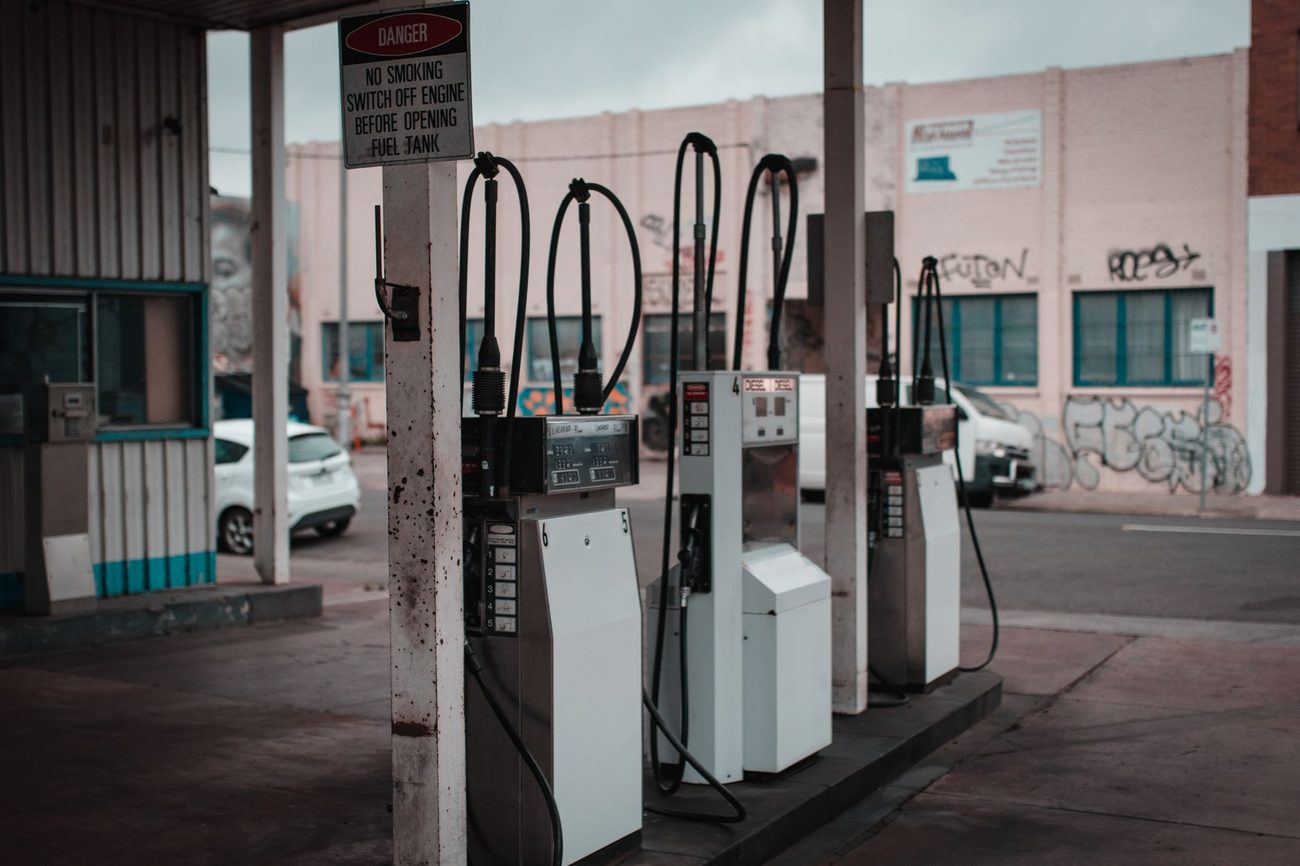
The pump clicked off at $61.41 last Tuesday, and I wrote it in the spiral notebook the same way I have since 2016: date, odometer, gallons, price. 133,240 miles. 21.25 gallons at $2.89. Then I did something I hadn't done in a while, which was ask what all those little lines add up to for one ordinary trip to work.
The answer is not dramatic. That's sort of the point. Small numbers that repeat 240 times a year are the ones worth knowing, the same way at work a few cents a mile on one lane matters more than one big invoice.
We live on the north end of St. Joseph. I'm a dispatcher at a freight terminal on the east edge of town, just off US-36. It's 11 miles each way, 22 round trip, a mix of city streets, a stretch of the Belt Highway and a short run of four-lane at the end. My shift starts at 6:30, so I'm out of the driveway around 6:05 and home a little before 3:30.
The truck is a 2014 Silverado 1500 with the 5.3-liter V8 and four-wheel drive. Across the last six months of notebook entries it has averaged 16.1 miles per gallon on commuting tanks. Call it 16. On a long highway trip it does better, and in January with the heater running during warmup it does worse, but 16 is honest for what I ask of it most days.
The math at $2.89 a gallon
At 16 mpg, 22 miles takes 1.375 gallons. At $2.89, which is what regular cost me here in town last week, that works out to:
- Per day: $3.97
- Per week (five shifts): $19.87
- Per month (about 21 working days): $83.45
- Per year (about 240 days after vacation and holidays): $954
That's gas only. Every fourth Saturday I'm on call, and maybe half of those I end up driving in, so add roughly $26 a year. Call the commute a thousand dollars of gas a year and you won't be far off. Missouri's gas tax is also stepping up again in July, one more step in a series, so I don't expect $2.89 to be the number all year.
What the gas number leaves out
At work I'd never price a lane on fuel alone, so I won't do it to myself either. The truck takes 8 quarts of 0W-20. I changed it myself in March for $46 in oil and a filter, against $94 at a quick-lube place. At a change every 5,000 miles, that's under a penny a mile. Tires are the bigger one: a set for this truck runs around $900 installed and should go 50,000 miles or so, which is close to two cents a mile.
Put gas, oil and tires together and my commute runs about 21 cents a mile, or roughly $4.60 a day. I'm not counting insurance or what the truck is worth, because I'd pay those whether I drove to work or not. This is just the cost of turning the key and going.
A few things in my control move that number a little. Tires at the pressure on the door sticker, checked once a month in the driveway. Not letting the truck idle ten minutes on a mild morning just because the radio is good. Not stopping at the gas station that's always a dime higher because it's on the right side of the road. None of that is exciting, and all of it shows up in the notebook.
Would a smaller car pay for itself?
Tina asked me this over supper, which is fair. If I commuted in something getting 32 mpg, the gas would be about $1.99 a day instead of $3.97. Over a year that's roughly $475 saved. That sounds like real money until you price a decent used commuter car, plus a third set of plates, a third line on the insurance and a third thing to maintain. At $475 a year, a $6,000 car takes better than twelve years to break even, and that assumes it never needs anything. It will.
Swapping vehicles with Tina doesn't help much either. Her Sienna gets about 19 around town, which would be $3.35 a day for my drive. She also does a lot more stop-and-go than I do, hauling two kids to two schools and a volleyball gym, so the van is better used where it is.
There's also the thing a spreadsheet doesn't capture. The truck is paid for, it has four-wheel drive for the two or three mornings a winter when US-36 is a skating rink, and it hauls the mulch, the mower and my dad's lawn chair. A commuter car would save me gas and then I'd borrow somebody's truck twice a month.
So the Silverado stays the commuter, and I'll keep writing the fill-ups in the notebook. My plan is to rerun this math whenever gas moves more than a quarter a gallon, mostly so I'm not guessing when somebody at work starts complaining about prices. The truck doesn't care either way. It drinks what it drinks. We'll run it till it tells us otherwise.